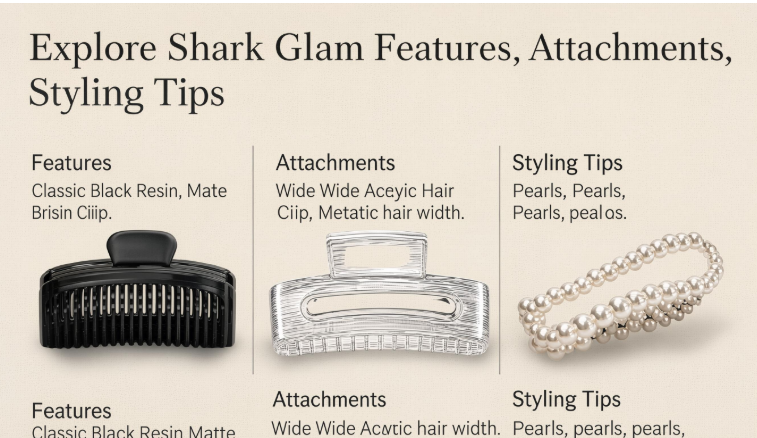
Explore Shark Glam Features, Attachments, Styling Tips
A great hair tool should do more than look impressive on a bathroom counter. Shark Glam is designed for people who want to dry, straighten, curl, smooth, and add shine without reaching for several separate devices every morning.
That promise matters because styling routines can become expensive, time-consuming, and hard on the hair. A multi-styler only earns its place if it saves time, works with your texture, feels intuitive, and delivers results you can repeat after the first exciting trial.
The tool combines powerful airflow with heat-controlled ceramic technology, giving it a different personality from air-only stylers. Depending on the set, users can create sleek finishes, glossy blowouts, wrapped curls, defined natural texture, or polished flyaway control with one motor base.
This guide explains what the system does, how its main attachments work, where it performs best, and what to consider before buying. It also covers practical techniques for different hair types, maintenance, common mistakes, and realistic expectations.
What Is Shark Glam?
Shark Glam is a wet-and-dry hair styling system that combines a high-speed dryer with interchangeable attachments. The distinctive feature is its use of both airflow and heated ceramic surfaces, particularly in the Silki straightening tool and Glossi styling brush.
Unlike a basic blow-dryer brush, the system is intended to handle several stages of a routine. You can rough-dry the roots, smooth the lengths, build volume, create curls, straighten sections, define natural texture, and finish flyaways without switching between unrelated appliances.Caption: Clean sections and controlled tension usually matter more than rushing through large pieces of hair.
The brand positions the tool for a wide range of hair patterns, from straight and wavy hair to curls and coils. However, the exact experience depends heavily on the attachments included in the bundle, the thickness of each section, moisture level, product choice, and the final look you want.
The system also has a rotating body that changes from a dryer-like shape to a wand-like styling position. That design makes it easier to aim airflow during rough drying and then hold the tool vertically when using brushes, curlers, or finishing attachments.
How the Technology Works
The central idea behind Shark Glam is that airflow can remove moisture while controlled ceramic heat shapes and smooths the hair. Traditional flat irons mainly use direct contact heat, while air stylers mainly rely on moving air and tension. This system brings both methods together.
Shark states that its Heat Sense Technology measures temperature repeatedly and regulates the output during styling. The company also describes a Scalp Shield setting intended to reduce extreme heat near the roots and scalp during wet-to-dry use.
[Infographic: “The Five-Step Styling Process” showing rough-drying, sectioning, attachment selection, styling, and finishing.]
Caption: Consistent results come from matching moisture level, section size, and attachment to the chosen style.
The wet and dry modes are important because hair behaves differently at each stage. Damp hair can be reshaped as it dries, which is useful for blowouts and straightening. Dry hair responds better to touch-ups, smoothing, curl refinement, and shine-focused finishing.
The tool is not fully automatic. It still requires sectioning, tension, direction, and a little practice. People who expect one quick pass through a full head of unsectioned hair may be disappointed, while users who follow a repeatable method are more likely to see polished results.
Understanding the Main Attachments
The value of any multi-styler depends on its attachments. Names and bundles can vary by market, so buyers should check the exact contents rather than assuming every box includes the same accessories.
Shark Silki Hot Tool and Air Straightener
The Silki attachment combines ceramic straightening surfaces with directed airflow. It is designed for wet-to-dry straightening and dry touch-ups, making it one of the main differences between this system and a conventional air styler.
Work with small, detangled sections and steady tension from roots to ends. Fine or lightly wavy hair may smooth quickly, while thick, coarse, curly, or highly textured hair usually needs narrower sections and more root preparation. The finish may look fuller than the pin-straight result of a traditional flat iron.
Shark Glossi Hot Tool and Air Glosser
The Glossi attachment functions like a heated air-styling brush. It is designed to smooth, shape, add body, and create a polished blowout effect while drying or restyling the hair.
Lift at the roots, place the brush beneath a section, and keep gentle tension toward the ends. Roll inward for a rounded blowout or pull downward for a smoother finish. It can also refresh dry lengths between washes.
Coanda Auto-Wrap Curlers
The curlers use airflow to attract and wrap hair around the barrel. This can reduce the hand coordination needed for a traditional curling wand, although learning the correct direction and section size takes practice.
Start with mostly dry hair unless your model’s instructions say otherwise. Let the airflow catch the ends, bring the barrel toward the roots, and allow the curl to cool before brushing. If curls drop quickly, use smaller sections, less moisture, more hold product, or temporary pinning.
Styling Concentrator
The concentrator directs airflow for rough drying, root control, and smoother blow-drying. It is useful at the beginning of the routine, particularly when the roots are wetter than the lengths.
Aim the airflow downward along the hair shaft to reduce roughness. Avoid blasting the ends from different directions, as this can make the finish look less polished.
Oval Brush
The oval brush is intended for volume, smoothing, and movement. Its shape helps lift roots and curve the ends, making it suitable for layered cuts and classic blowout styles.
Use moderate sections and keep the brush moving. Large sections may dry on the outside while remaining damp underneath, which weakens the style and increases the time spent restyling.
Diffuser and Wide-Tooth Comb
Some sets are built for curly and coily hair and may include a curl-defining diffuser or wide-tooth comb. The diffuser spreads airflow to help preserve curl shape, while the comb can stretch and lengthen textured hair during drying.
For curls, apply styling product evenly and avoid excessive touching as the shape sets. For stretching, use steady tension without pulling aggressively.
FrizzFighter Finishing Tool
The finishing attachment is used on dry hair to smooth visible flyaways and refine the surface. It is not a replacement for good preparation, but it can make a noticeable difference after the main style is complete.
Use it lightly over the top layer rather than repeatedly pressing through the same area. Too many finishing passes can flatten volume or make the roots look heavy.
How to Use Shark Glam for Better Results
Using the system well begins before the tool is switched on. Hair should be clean enough to move freely, thoroughly detangled, and prepared with products suited to its texture and the chosen finish.
Start with a lightweight heat protectant. Fine hair needs minimal product to preserve volume, while coarse or porous hair may benefit from a smoothing cream or leave-in conditioner. Mousse can improve hold, but excess product may create stiffness and buildup.
Start With the Right Moisture Level
For wet-to-dry straightening or blowouts, towel-dry until the hair is damp rather than dripping. Curls often form better on mostly dry hair. Before dry touch-ups, confirm that no hidden moisture remains unless the selected attachment is designed for damp use.
Divide Hair Into Manageable Sections
Sectioning is one of the biggest differences between average and polished results. Clip the hair into four or more zones, then create smaller working sections within each zone.
Fine hair may tolerate wider pieces, while dense, curly, or coarse hair usually benefits from narrower sections. If the tool cannot reach the inner strands evenly, the section is too large.
Match Speed and Heat to Your Hair
More heat is not always better. Fine, fragile, bleached, or damaged hair generally needs more conservative settings and fewer passes. Thick or resistant hair may require stronger settings, but technique should still do most of the work.
Allow airflow, ceramic contact, and tension to work together. Moving too fast leaves moisture and shape behind; moving too slowly can overwork the section.
Finish and Let the Style Set
A style is not fully formed until the hair cools. After curling or shaping, avoid immediately brushing through the section. Use a cool shot when appropriate and give the hair a few minutes to settle.
Finish with a small amount of serum, oil, or flexible hairspray only where needed. Heavy finishing products can undo volume and make freshly styled hair look coated.
Styling Tips for Different Hair Types
No multi-styler performs identically on every texture. The most useful approach is to adjust section size, moisture level, product, and expectations rather than copying one universal tutorial.
Fine or Straight Hair
Fine hair can style quickly but may struggle to hold volume. Use lightweight products, avoid saturating the roots, and choose small curling sections. Lift with the Glossi or oval brush, then let each section cool before touching it.
Wavy Hair
Wavy hair responds well to smoothing and volume attachments. Rough-dry the roots, then use controlled tension through the lengths. Choose Silki for a sleeker result or Glossi to preserve movement while polishing the surface and ends.
Curly Hair
Curly hair requires a clear decision: define the existing pattern, stretch it, create a blowout, or straighten it. Trying to do all four at once usually creates inconsistent results.
Use the diffuser for definition, the wide-tooth comb for stretching, or the concentrator followed by a smoothing attachment for a blowout. Apply products evenly while the hair is wet, and avoid letting some sections dry completely before others are styled.
Coily or Highly Textured Hair
Coily hair may need more preparation, smaller sections, and careful root control. Moisture balance is important: the hair should feel conditioned and flexible without being overloaded with heavy products.
For straightening, begin with a thorough detangle and stretch the roots before expecting a sleek finish through the lengths. For elongated or blown-out styles, work slowly and focus on even tension. Results can be smooth and polished, but the process may take longer than promotional demonstrations suggest.
Bleached, Fragile, or Damaged Hair
Compromised hair needs a cautious routine. Use the lowest effective setting, avoid unnecessary repeat passes, and stop if the hair becomes unusually dry, rough, or stretchy.
A tool marketed around regulated heat is not a guarantee against damage. Hair condition, chemical history, technique, frequency, and product use all influence the outcome.
What Results Can You Realistically Expect?
The strongest reason to consider this system is versatility. It can potentially replace or reduce the need for a separate dryer, hot brush, curling tool, diffuser, flyaway attachment, and straightener, depending on the bundle and your preferred styles.
Independent beauty reviewers have generally praised its ability to move between straight, wavy, curly, and coily styling routines. Some testers have highlighted faster drying, strong smoothing, and useful wet-to-dry performance.
However, results are not universally perfect. One commonly discussed limitation is that the ceramic attachments combine heat with airflow, and users may not have the freedom to control those elements as independently as they would like. That can matter to people who prefer very precise temperature management.
The tool can also feel noisier or more complex than a simple straightener. There are multiple settings, modes, and attachments, so the first few sessions may involve experimentation. Buyers looking for one effortless button and identical results on every texture may find the learning curve frustrating.
Comparison With Shark FlexStyle
The FlexStyle is primarily an air-styling system, while the newer tool adds heat-controlled ceramic attachments for stronger straightening and glossing. That difference is the main reason to choose one over the other.
Choose the newer system when wet-to-dry straightening, ceramic smoothing, and glossy blowouts are central to your routine. Choose FlexStyle when you mainly want drying, air wrapping, brushes, and lower-cost versatility without the newer ceramic-focused tools.
The attachments are not generally interchangeable between the systems, so existing FlexStyle owners should not assume they can buy a Silki or Glossi head and attach it to their current base. Compatibility should always be confirmed for the exact model number.
Comparison With Dyson Airwrap and Airstrait
The comparison spans two Dyson products: curling and blowout functions compete with the Airwrap, while wet-to-dry straightening overlaps with the Airstrait. The main attraction is consolidation into one system.
Dyson users may prefer its controls, attachment behavior, or familiar ecosystem. The better choice depends on your dominant style: frequent straightening creates different priorities from diffusing curls or making loose waves.
Cleaning, Storage, and Maintenance
Keep airflow clear by checking the filter and removing lint according to your model’s instructions. After unplugging and cooling the tool, wipe permitted surfaces with a soft, slightly damp cloth and remove product residue from bristles. Never soak electrical parts.
Store attachments where plates and bristles will not be crushed or scratched. Keep the cord in a loose coil rather than wrapping it tightly around the body.
Common Mistakes to Avoid
The first mistake is working with sections that are too large. This leaves hidden moisture, reduces tension, and forces repeated passes.
The second is using the wrong attachment for the desired result. A diffuser preserves curls, a straightener aligns them, and a rounded brush creates movement. No single attachment is ideal for every finish.
Other common errors include:
- Starting with dripping-wet hair
- Skipping detangling
- Using too much oil before heat styling
- Holding ceramic tools still for too long
- Brushing curls before they cool
- Ignoring root moisture
- Expecting identical results on every texture
- Failing to clean filters and brush heads
- Buying a bundle without checking the included attachments
Technique improves quickly when you change one variable at a time. Adjust section size first, then moisture level, product quantity, temperature, or finishing method.
Who Should Buy It?
This system makes the most sense for someone who regularly creates more than one type of style. If you alternate between straight hair, bouncy blowouts, curls, and natural texture, a flexible attachment set may reduce clutter and simplify your routine.
It may also suit buyers who like the idea of wet-to-dry styling but still want the polished feel of ceramic tools. People with limited storage can benefit from one base replacing several full-size appliances.
It may be less suitable for someone who only uses a basic dryer, rarely heat-styles, or already owns premium tools that cover every function. The cost is easier to justify when several attachments will be used consistently.
Travelers should also check voltage, plug type, size, and storage needs. Premium multi-stylers can be more convenient than carrying several tools, but they are not always compact or dual-voltage.
Is This Multi-Styler Worth It?
Shark Glam is worth considering when versatility, wet-to-dry styling, and a polished finish matter more than having the simplest possible tool. Its strongest advantage is the way it combines air styling with ceramic straightening and glossing in one system.
The decision should still be based on your routine rather than the number of attachments in the box. List the styles you create in a normal month, identify the tools you already own, and compare that with the exact bundle. An attachment you never use adds little value.
Buyers with thick, curly, or coily hair should pay close attention to bundle contents and realistic timing. The right diffuser, comb, or straightening tool can make the system more useful, but dense textures may still require patient sectioning.
For the right person, the system can reduce styling clutter and produce repeatable salon-inspired results. For someone who needs only one straightforward function, a dedicated dryer, brush, diffuser, or straightener may be the smarter purchase.
Frequently Asked Questions
Can this styler be used on wet hair?
Yes, selected attachments and modes are designed for wet-to-dry styling. Hair should generally be towel-dried and detangled rather than dripping. Always follow the instructions for the exact attachment and model.
Does it work on curly and coily hair?
It is designed for a broad range of hair types, but performance depends on the bundle and technique. Curly and coily users may benefit from the diffuser, wide-tooth comb, concentrator, and Silki attachment, along with smaller sections and careful preparation.
Can it completely replace a flat iron?
For many users, the Silki attachment may create a smooth, straight finish without a separate flat iron. People who want an extremely flat, glass-like result or who have very resistant roots may still prefer a dedicated straightener for occasional finishing.
Is it safe for damaged hair?
No heated styling tool is risk-free. Use conservative settings, heat protectant, minimal passes, and careful sectioning. Severely damaged or breaking hair may need a reduced heat routine and professional advice.
How long do the curls last?
Hold varies by hair type, weather, products, section size, and cooling time. Mostly dry hair, smaller sections, styling mousse, and allowing curls to cool before brushing can improve longevity.
Are Shark FlexStyle attachments compatible?
Generally, no. The newer attachment system uses a different base design and technology. Check the exact model and official compatibility information before purchasing separate accessories.
Which attachment is best for a blowout?
The Glossi or oval brush is usually the most direct choice for volume, smoothness, and curved ends. The concentrator can help pre-dry the roots before the brush is used.
Is the tool difficult to learn?
The basic controls are approachable, but switching between moisture levels, settings, directions, and attachments takes practice. Most users should expect several sessions before achieving consistent results.
Conclusion
A premium multi-styler should make a routine more flexible, not more complicated. Shark Glam stands out because it combines powerful drying, air wrapping, heated smoothing, and wet-to-dry straightening in a single attachment-based system.
Its best results come from realistic expectations and disciplined technique: start with the correct moisture level, use manageable sections, select the attachment for the finish you want, and allow the hair to cool before judging the result.
For users who enjoy changing their style and want to replace several tools, the system offers meaningful convenience. For those who use only one styling method, a simpler dedicated appliance may provide better value. The smartest choice is the one that fits your hair, habits, and actual morning routine rather than the most impressive demonstration oline.